Tricking A Horse Into Calmness, Academy

I don’t know if you can tell in the video just how windy it was while we were trying to work. The gate in the background is banging and clanging. Heildorf is still very worried about this riding stuff. It was a recipe for disaster.

So how do we work through days like this?

By doing tricks!

Heildorf started out worried about everything. I went to touch his saddle and he jumped away. I let him go and took a step back. Forcing the contact wont offer him any comfort at all. I asked if I could touch him, letting him step away when he needed until he was comfortable with it. Once he allowed me to readjust it on his back I rewarded him by letting him do the trick he had been asking about all day.

Because tricks are fun the horses can concentrate on them instead of worrying about the wind and all the things going on around them. Because the horse wants to concentrate on the fun tricks he is happy to ignore the wind and things that would be scary. By the time we are well into the tricks the banging and flapping has become background noise we are both accustomed to. I can stop worrying that he will be scared by the wind. He is focused and unconcerned.

Because I am on the ground instead of on his back I am far less likely to get hurt if he did spook.

Tricks can make for a great warm up. Whether for a green horse or an older horse on spooky days. It’s amazing what can be accomplished just by having fun.
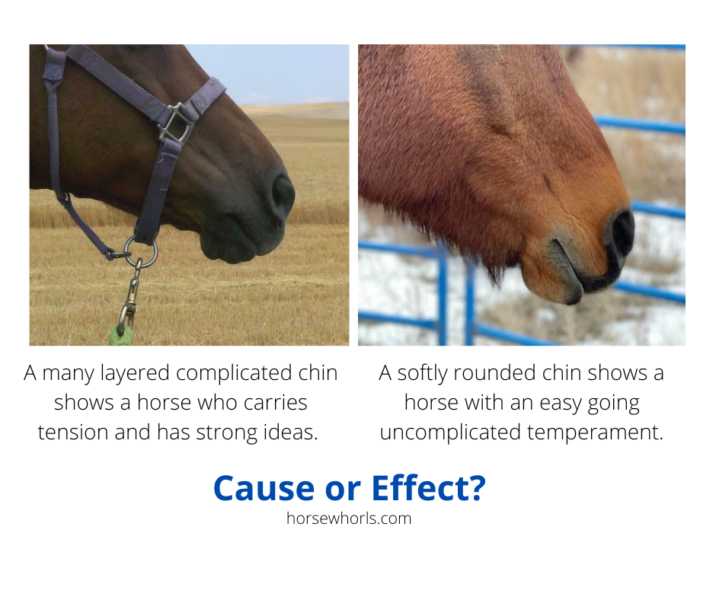
Cause Or Effect? Horsewhorls

There are so many parts of the horses head that give us clues to their temperaments.

The chin and lips are some of these. They are unique from things like eyes and ears in that they are muscle.

The shape of eyes, ears, and profile are fairly well set. The horses are born with them and they don’t change. Chins and lips change and grow with the horse as the horse matures and develops their own unique personality. Which brings us to a very important question.

Does the shape of the chin and lips, the muzzle, show what the temperament will be or does the temperament cause the shape of the muzzle?

Frown lines don’t cause a person to spend their time frowning. Frowning causes frown lines to develop. Or, to the contrary, laugh lines. The way a person thinks, acts, and holds themselves is the cause of the way the lines of the face develop.

If a horse is curious and wants to explore with their mouth does this develop the muscles in the upper lip making it shapely and curvaceous? If a horse carries tension in tightly drawn lips does this build the muscling of the lips and chin adding lines, ridges, and layers for a complicated chin?

Some things, certain shapes and characteristics, are inherent and unchanging. A chin that comes to a point that gets hard with the lip flattening and extending when the horse is upset, is a born trait that accompanies several other traits. The sensitive skin that tends to wrinkle more than normal, that accompanies this chin type is far deeper than muscle development.

Looking at the way the muzzle develops over time can give us a lot of information. How much is cause and how much effect? That is hard to say.


Treats

What do your cattle like to eat?

It might seem like a silly question. They like grass, hay, grain. All the usual things cattle are supposed to eat.

That goes without saying.

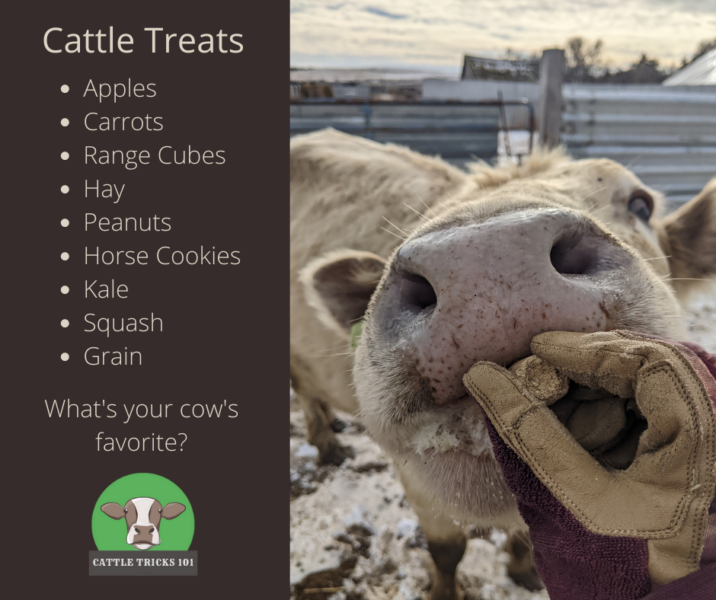
But what else do they like to eat? Cattle are actually known for being rather adventurous eaters. They can eat almost anything. Kale and bread are reported to be favorites. Apples and carrots have the same effect on cattle as they do horses. People feed their cattle anything from donuts and Oreos, to peanuts and cucumbers.

Mine are big fans of squash. We clean out the pumpkin patch every fall and throw them to the cattle. It adds interest to their diet and gives them something to keep them entertained. Almost any garden produce can be shared with cattle

Of course there are some things cattle shouldn’t eat. Fruits with large pits like peaches or avocados need to be avoided. There are plenty of foods in their pastures that are unhealthy for cattle to eat so taking care in what we offer them as a treat isn’t an unusual step in caring for cattle.

What odd treats do you give to cattle?


Using Whorls To Choose Cattle, Horse Whorls

Whether choosing a steer to train or picking out a heifer or bull, we can gain clues to what they will be like by looking at the whorls on cattle’s head.

Whorls form in utero as the rest of the animal develops. When there is any abnormality in the cells, a whorl in the hair develops over it. As the brain forms, whorls develop where there is activity. Whorls on the outside of a cow give us a unique view to what is going on inside the cow. We can use them to judge temperament, health, and fertility.

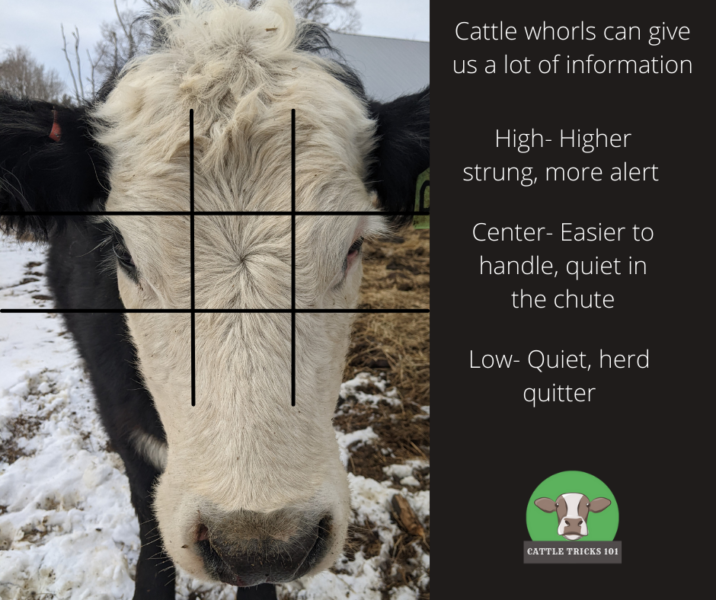
There have been many studies done on cattle and their reactions to being run through the chute in comparison to their whorls. For the most part, cattle with center whorls were quieter and didn’t fight as much as cattle with higher whorls. Like in horses, high whorls show on cattle show an extrovert, energetic and reactive. This isn’t necessarily a bad thing. They are also curious and interested in everything around them. In a small study, cattle with high whorls were less likely to lose calves to predators. Being aware of surroundings and alert to everything around them can have benefits.

No whorls at all show the same basic temperament as a high whorl.

A center whorl is normal and basic. It shows that there are no extremes of temperament in any direction. They are generally thought to be easier to train.

Low whorls show quieter cattle. A good thing, but there are pros and cons to everything. Cattle with low whorls have been found to be harder to handle in a herd, they will leave instead of staying in the bunch. They are also more likely to lose calves to predators.

Any unusual whorls, long lines or set off to the side, show low fertility or difficult temperaments. Bulls with long whorls have been found to have very low fertility.

We can gain knowledge from the whorls across a cows body too. A long line, horizontal across the lower belly, can tell us if a cow is bred. High whorls on either side of the brisket are a sign of good health. Whorls on the hind legs show rich milk.

There are so many ways we can make use of cattle whorls to tell if they will suit the job we have in mind for them. It’s well worth a look at the whorls on your cattle!


Pectoral Whorls, Horsewhorls

All horses have them. A feathered whorl down each side of the chest above the front legs.

Usually the pectoral whorls are even. either both reaching high into the chest or both short and compact. The breed, type, and movement of the horse reflected in the hair.

Sometimes that isn’t the case. Occasionally the whorls will be uneven, one higher than the other. When this happens there will be a leg preference. The horse will want to reach farther with the leg that has the higher whorls. This will be the preferred lead, as the horse want to reach with that front leg.

What other consequences can it have?

It goes without saying but still needs to be drilled into our heads, the entire body is connected. When there is something going on in one place it affects all the other body parts.

When a horse is out of balance in the front legs, what does it do through the rest of the body?

The first thing we would do is check the underside of the jaw and belly to see what those whorls look like. If they are even the effects will be less. If those whorls are uneven too, the whole body will be working against itself. The crookedness having far reaching consequences.

The higher pectoral whorl shows a stronger front leg. That strength and preference is echoed in the opposite hind leg. With these two legs being strongest, the hind leg opposite the low whorl will be weaker. Between overloading the front leg with the lower whorl because they like to use and reach with the leg with the higher whorl, and overloading that front leg because the corresponding hind leg is weaker, the leg with the lower whorl is more likely to be injured. This can range in severity from tendon and other soft tissue injuries to uneven hoof angles, hi/low syndrome.

The connections through the entire body are so strong that any unevenness ricochets from the chest through the hind quarters then back to the front legs. Little thing,s like a slightly stronger front leg, can have far reaching effects.


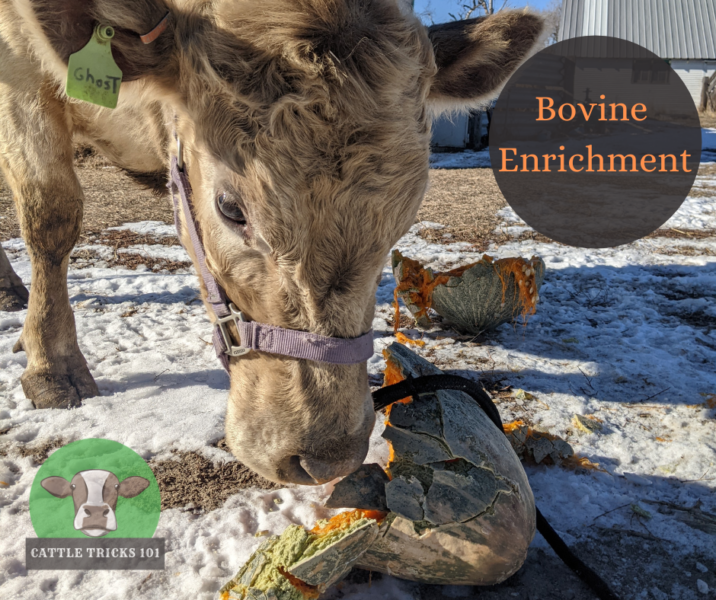
Bovine Enrichment

Cattle enjoy variety.
Adding a little bit of something extra to their feed can keep them entertained and add nutrients to their diets. Cattle can eat most fruits and vegetables that we eat regularly. With the exceptions of fruits with large pits such as apricots and cherries it is perfectly safe to share our treats with them.
Table scraps can be put out for cattle just like they can for chickens as long as we are careful to collect only foods that are suited to cattle. Garden left overs are wonderful to set out for cattle to sort through and enjoy. We put all the squash that is left in the garden come fall out for the cattle to enjoy. They love the seeds and will eat the flesh down the the outer skin.
Or pick up a few extra fruits while at the store next time. Kale is a cattle favorite. You can test out different fruits to see which is your cattle’s favorite. Try bananas, grapes, or kiwi to change things up a bit.

Neck Whorls, HorseWhorls

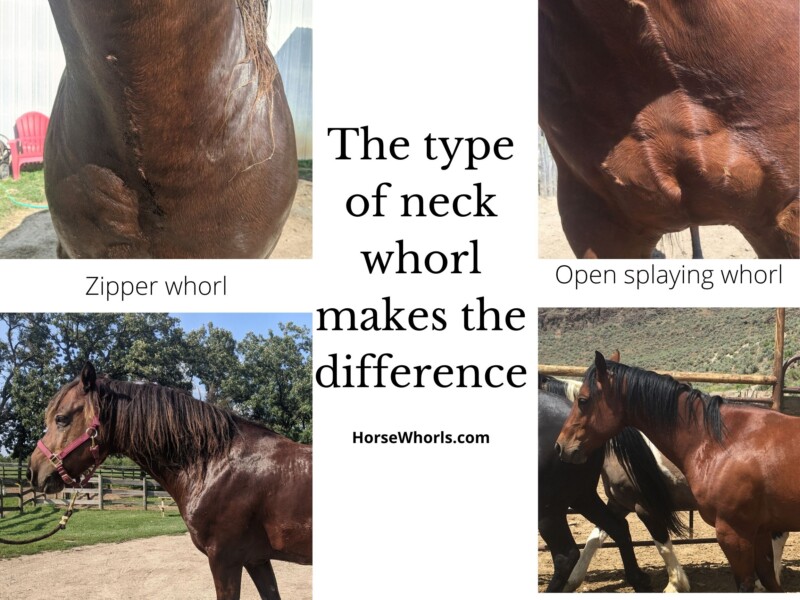
Lots of horses have whorls down the underside of their necks. Most of them are small enough that they don’t make a lot of difference. A small whorl will be a small spot in the neck where the neck will be straighter. There will be a little bit of extra muscling there.

As the whorls get bigger the effect they have will grow. Long whorls the length of the neck will make a major difference in how the horse carries the neck. What that difference will be depends on the type of whorl. There are two basic types of whorls that take up space under the neck.

A zipper whorl is narrow and tight. The hair grows towards center making a ridge along the middle of the whorl. These whorls lead to an arched neck. A high arched neck if they are only on the neck, or a low neck that is carried forward instead of up but rounds nicely if the whorl goes down into the chest. These horses have a natural tendency to carry themselves balanced and working off the hindquarters.

An open splaying whorl, for lack of a better name, has hair that grows outward from center. If there is a ridge of hair it is along the outer edges of the whorl, circling it like a frame. A neck will curve downward into these whorls. Often horses with open splaying whorls will be built down hill and want to carry their noses in the air. With poor riding these whorls can accompany horses who will be uncomfortable and poorly balanced. They need help finding a good way to carry themselves.

Two very similar whorls with two very different outcomes. The small details are always important.


Mule Whorls, Horsewhorls

Looking at the forehead whorls on horses is understood and there are fairly basic rules. High shows an extrovert. Low shows and introvert. That much is simple.

What happens when we start looking at some not so basic equines though?

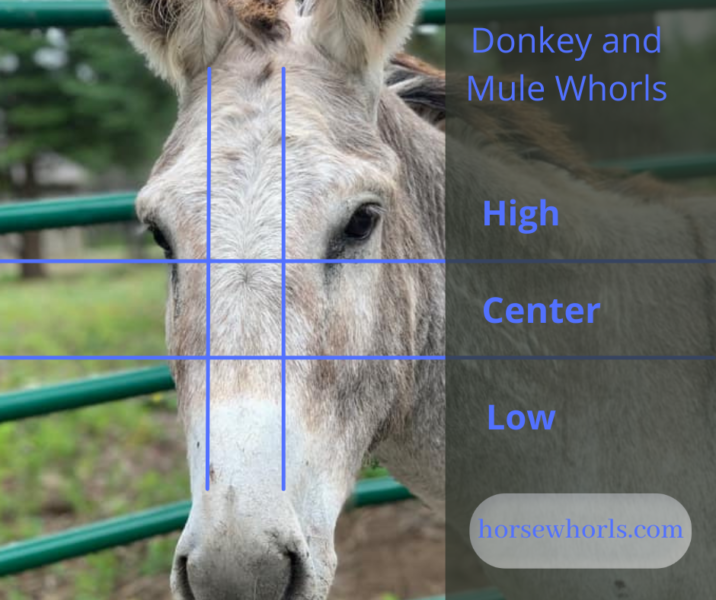
Most mules and donkeys have low whorls. Those low whorls almost always have feathering. Does that mean that all donkeys and mules, I’ll call them long ears for ease of typing, are left brain introverts? Is there so little variation among them?

No, It doesn’t.

Long ears are different than horses in more ways than just the ears. Whorls on horses are located in close relation to the olfactory bulbs. The olfactory bulbs receive information about smells from the nose and send it to the brain by way of the olfactory tracts. These are very important to equines who have such a strong sense of smell. It isn’t surprising that whorls would be related closely to such a strong link to the brain. The olfactory bulbs in long ears are smaller and rotate inwards. Their whorls are NOT in as close of relation to the olfactory bulbs as horses are.

Instead long ears have whorls that are set farther down the face.

A center whorl on a long ear is half way down their nose in a position that would be an extremely low whorl on a horse. A whorl centered between the eyes is a high whorl for a long ear. There can still be low whorls on donkeys and mules, they are just lower low whorls.

Seeing an extrovert long ear is very possible! They posses all the usual patterns we would expect to see in horses, High whorls, low whorls, even double whorls. The one whorl type that is far more common in long ears than horses is no whorl at all. This shows a right brain animal, emotional and sensitive.

We can apply all the rules of whorls to long ears that we can to horses. We just need to readjust our view a little.


Winter Exercise

Harvey and I have been working on a small dance routine. Or were before it got so cold. It is a simple collection of movements put together and repeated in the same order, over and over. Not drilled to the point of boredom and misery. The repetition is so that he will know what is coming next. If he can predict what will be next he should be prepared for it and ready as we finish one move to go on to the next.

Almost the exact opposite of anything we ever want in the show ring.

This isn’t the show ring. I would like him to anticipate a little. Be ready to shift his weight back to his hindquarters and perform the next piece.It hasn’t happened yet, but that is the goal.

Everything about Harvey’s conformation makes this difficult for him.He has a ‘swan’ neck that arches sharply just behind the poll. This allows him to tuck his head and have a prettily arched neck while still being completely hollow through the back. He has a long weak back. His hind legs are atrocious. Almost perfectly straight with weak pasterns that are a symptom of the hypermobility that effects his entire body. Because of these things learning to collect and use his body properly is even more important for him than for most horses with better conformation.

In order to make sure this exercise is building good muscle, instead of allowing him to go around dragging himself with his forequarters there are somethings I need to make sure of.

Front legs should always cross over in front when doing any lateral movements! Forward motion is the key to any good movement. If the feet cross behind you do not have it. This counts for the ‘twirl’, moving forequarters, and side passing.

When we do Spanish walk the hind legs need to keep moving! Sometimes they will want to move the front legs forward while the hind legs stay put becoming stretched out behind. We can fix this by clicking as the hind legs come forward and keeping moving before and after we ask for Spanish walk.

For a horse that is ride-able, unlike Harvey, doing some simple exercises like this can help keep them in shape for when the weather is more suitable to riding again. He, we, have a lot more work to do on our little routine before we have it down. It takes a while for the muscles to build up and be fully able to do these things well. Patience is always important.