Single Whorls, HorseWhorls

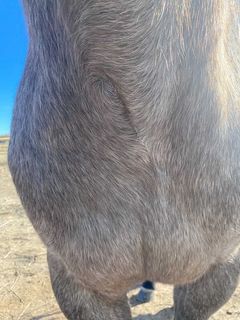
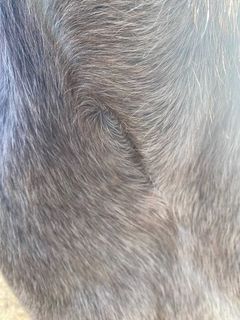
A single center whorl doesn’t tell us anything about the horses temperament, except that we can’t see any extreme’s from the whorl itself. It is neutral. That doesn’t mean that the horses temperament will be neutral.

Single whorls have a reputation for showing a quiet, dependable horse. That can be true, but isn’t a rule.

Instead when we see a sing;e center whorl we need to look at the rest of the head for clues to the temperament. Often the heads will show that, a simple, dependable horse, who will be straightforward and steady. Other times I’ve seen single whorls on a head that shows a difficult, complicated horse.

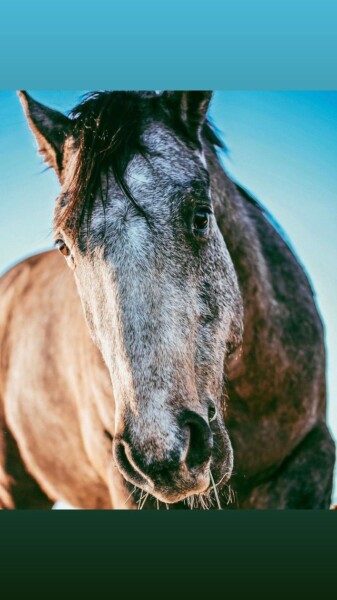
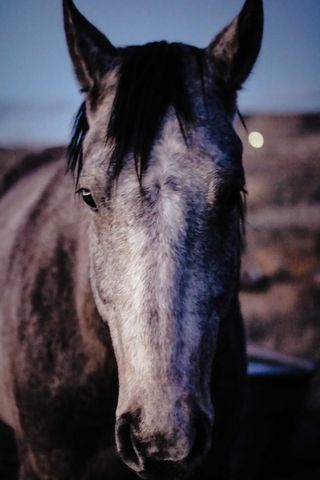
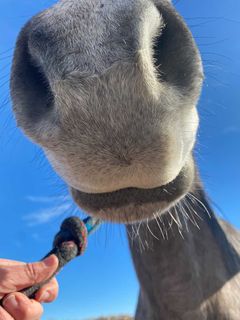
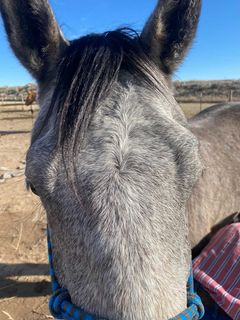
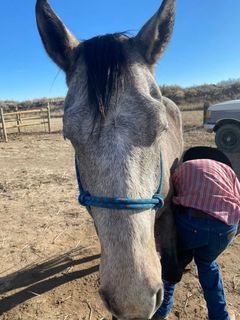
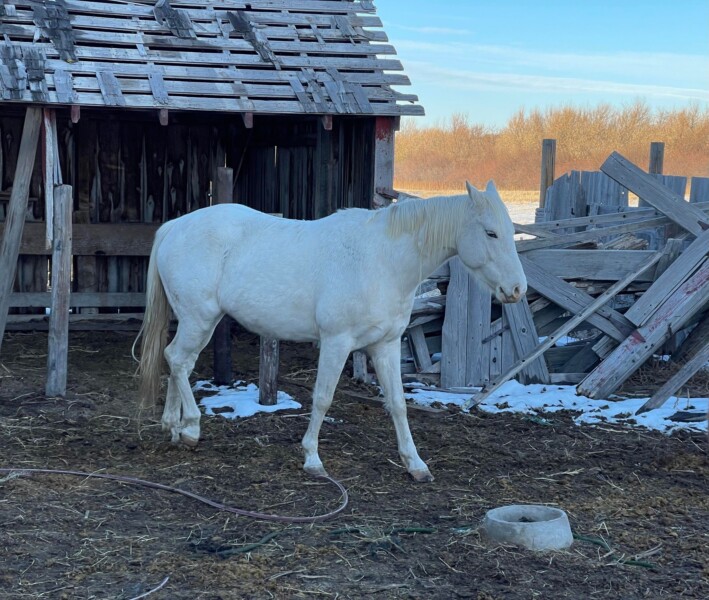
This horse has a single center whorl. So we need to look at the rest of the head.The ears are finely shaped, set wide on the head but very upright. That shows intelligence, sensitivity and energy. The eyes are wide set also, set out on the edges of the head. From that we see intelligence, an ability to learn quickly. Without a picture from the side we can’t tell what the profile looks like and the profile gives us some of the most powerful clues. It does give the impression of being mostly straight, mostly steady. The nostrils are wide open and round, alert, lots of room to take in air. They show a horse who will be alert to stimuli, the big nostrils allow lots of room to take in air. They aid a horse in learning quickly because they wont run out of breath. The jowls, also large, show the same thing.

The whorl on this horse is simple. The rest of the head has so much more to tell us.

Going Barefoot Again.

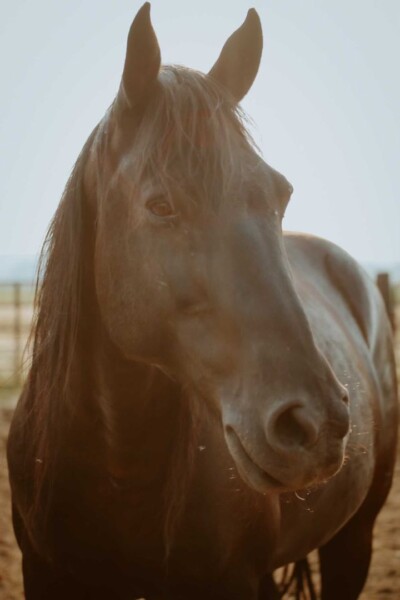
Rusty has been sore again. It’s been cold. His feet hurt.

The suspected culprit has been cold or winter founder from the beginning. When it gets cold the blood vessels into the feet don’t react properly, the feet get too cold, and you have founder. I’ve been keeping his legs wrapped. The only recommended cures are warmth. It’s either ship him off to a warmer clime or keep him bundled up.

The other thing we are trying is pulling the shoes until spring. The bit of snow we have on the ground was getting balled up in the shoes causing as much trouble as the shoes were fixing. Not that snow wont ball up on bare feet, but hopefully it will be less. The distortion is almost grown all the way out. With the toes trimmed back he should still break over far enough back to keep pressure off his toe. The farrier left a good bit of heel and kept the sole off the ground far enough to keep Rusty comfortable without shoes.

Hopefully he’ll go good barefoot again. I would really prefer to keep him that way. There’s a cold spell coming in. I’m going to double up his wrappings. Keep him as warm as possible. Hopefully spring will come soon.


The Basics

When we run into problems with our training we fall back to how good our foundation is.

When we run into difficulty our mind doesn’t help us. Usually it does the opposite and zones out. We forget to think and we forget to breath. Our horses are left hanging there by themselves trying to figure out what it is that we are asking of them. They will revert back to what they know best, or like to do best. If our training foundation is strong that can be good treat manners, standing quietly and waiting. If it isn’t they may revert to mugging and looking for treats.

We were asking them to do something, that must mean we meant to feed them, right?

They can also fall back on dangerous behaviors like nipping, running through us, or running off. With most horses the reversion wont be anything dramatic and dangerous, that still doesn’t mean that we want to go there.

By practicing the foundation behaviors over and over again until they are etched into our muscle memory we will automatically revert to them when we run into training trouble. We should reach the point where we automatically ask for, wait for, head forward before clicking and before asking for a trick. We should look for clickable behaviors without having to think about it all while remembering to breath.

Working on the ground, playing with our horses and tricks isn’t likely to be a life or death situation. What we practice in one area will transfer to any other area of work we do. By drilling those basics with our trick training we will remind ourselves to practice basics in all other aspects of our training. You never know, when a good foundation could save you.


Christmas Reins

This kid. This mare! She’s amazing. There have been moments as children’s interest wains, that I’ve wondered is we did the right thing getting her. Maybe she should go on to a home where other children need her more, would make better use of her.

Then there are days like this.

Trying out his new reins he got for Christmas 8  was tired of being lead. He wanted turned loose to steer all by himself. So we went to the corral and did just that. She’s a zippy little thing. But she never left a walk. She patiently went where asked, acknowledging his try instead of his lack of skill.

Someday he’ll be a great rider. Especially with her there to guide him along the way.


Grey Gelding, Horsewhorls

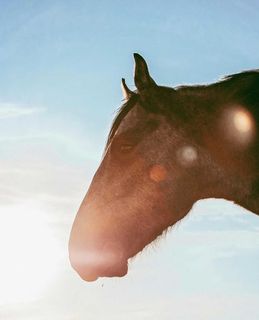
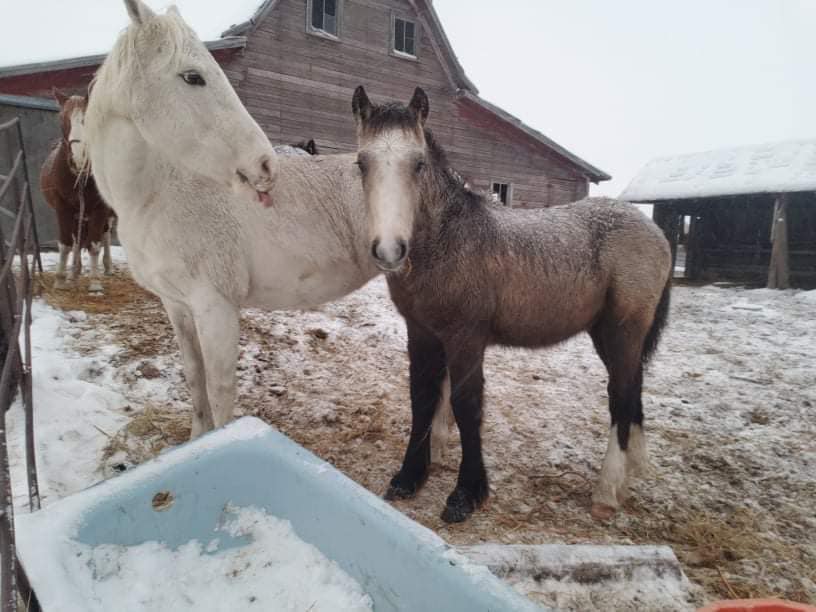
Sold at auction as a yearling, this horse sat in the feedlot until he was three. Luckily for him a loving family happened to drive by and spot him out there. They brought him home with them and he is now living the good life.  The first two pictures are him immediately after leaving the feedlot. The rest are later, after he had time to settle in.

He has a single whorl perfectly centered between the eyes. This only shows us that we don’t see any extremes of temperament from the whorl. We need to look at the rest of the head to get an idea of what he will be like.

From the side we see a slightly rounded profile, especially at the muzzle. He will have strong ideas of his own. Tough and determined as well as steady. His ears are set wide on his head showing intelligence and willingness. His head looks as simple and straightforward as we would hope to see with his whorl.

A short zipper whorl up the base of the neck will give a higher headset that arches nicely over the whorl and shows a horse who works well off the hind quarters.This one isn’t simple though it starts at a whorl off to the right side of the neck. The zipper whorl then runs at a slight angle over to the left side of the neck. Even more, the hair around the whorls grows to the right. When there is a single whorl on one side of the body, even when that whorl is connected to a bigger whorl pattern, the horse will turn more easily in the direction of the single whorl. The hair growing to the side adds emphasis to this. He should show some sidedness, a lead preference, an easier time circling one direction over the other. My guess is to the right. He could also bend to the right and throw the left shoulder out causing him to unbalance and take that lead.

It will probably not be a big deal, just something to be aware of.

It looks like the family who happened to drive by a feedlot and fall for the pretty grey horse standing out there mad a good choice.


Grey Mare, Horsewhorls

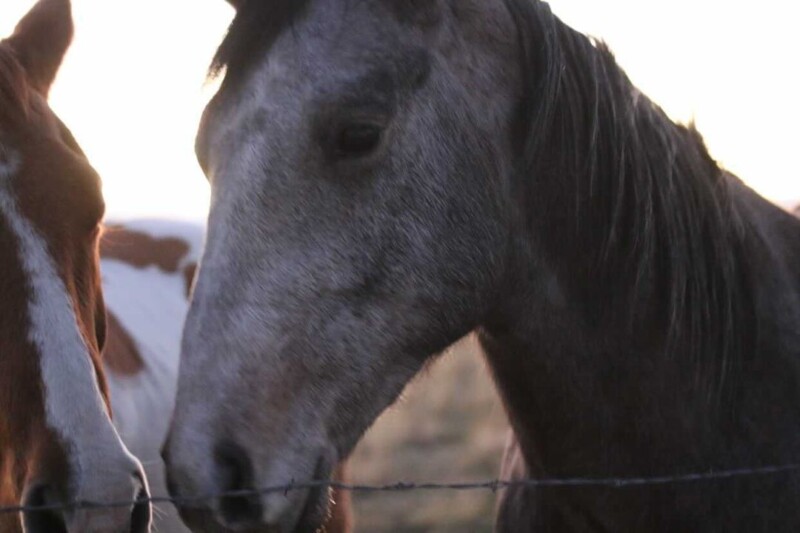
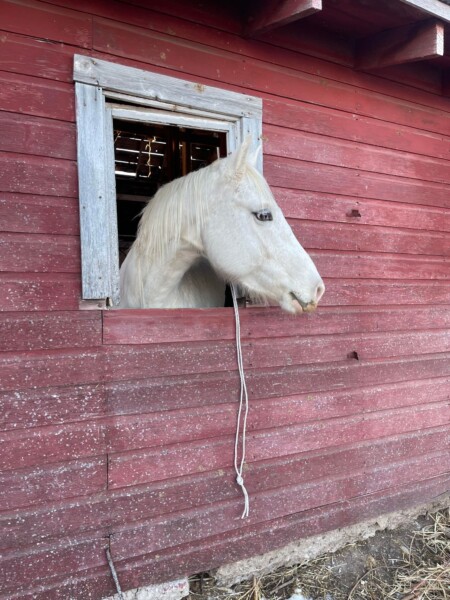
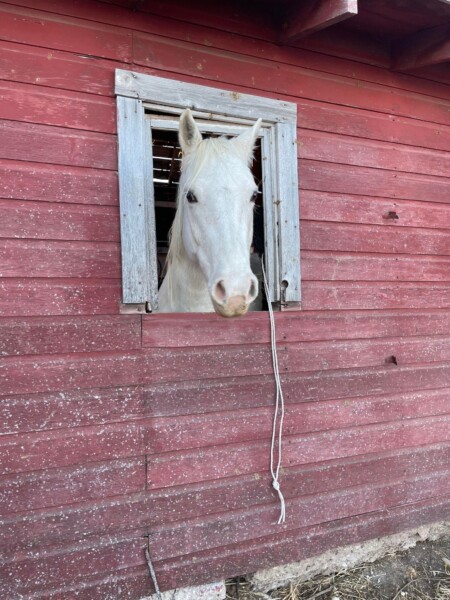
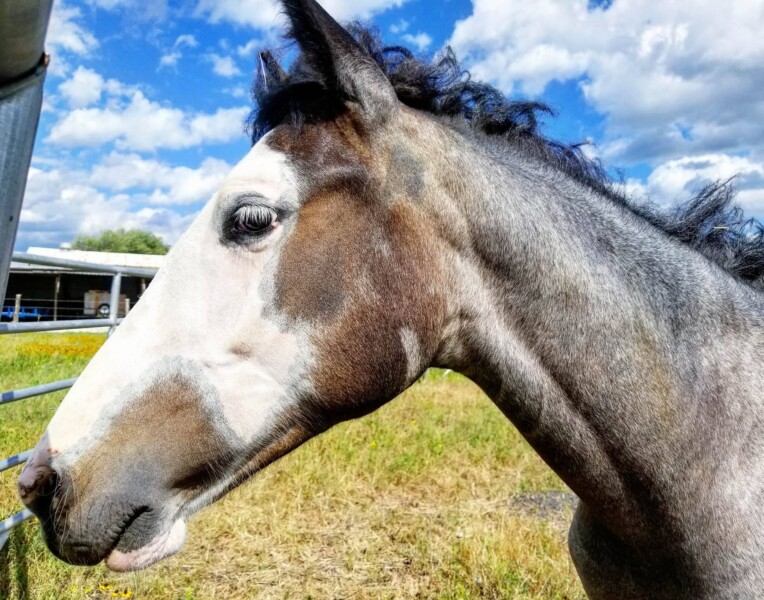
This mare has a single center whorl. That doesn’t make her simple. A single center whorl only shows that we can’t see any extremes of temperament from the whorl. It is still completely possible to see extremes from the head shape. Not that we see any extremes here, we also don’t see anything boring and simple.

From the front we can’t get a true reading of her eyes. This is why it’s so important to remember that pictures are only a moment in time. If the horse is in a normal state that works great. When the horse is stressed or nervous, like here, we could get a completely wrong reading from this moment in time. The ears are wide set and fairly broad themselves for an intelligent, willing horse.

From the side we see a hint of a dish and a hint of a moose nose for a sensitive but bold, confident horse. Nothing extreme but not overly simple. Her muzzle is squared off, steady, her jowl large, athletic. Her eyes stand out the most to me. It could be her black eyeliner that makes them seem so exotic. They look to be strongly almond shaped. She will hold judgement and see what she thinks about things instead of going along with the flow.

Her mane switches sides about two thirds of the way down. I would check for soreness. It could be something very small or it could interfere with future training.


Bad Luck Whorls, Horsewhorls

According to tradition some whorls are bad luck.

That is such a broad term. What exactly does it mean? How did someone decide such a thing?

I’m not one for superstition so I enjoy breaking it down and looking at possible causes for such superstition. One of the most famous whorls, and one of the easiest to break down is the shredded collar, a ‘wheat’ whorl up the base of the neck. First what does a wheat whorl look like? There are so many different types of whorls that appear on the base of the neck. Does that mean they are all ‘bad’?

I interpret the ‘wheat whorl’ as a big open splaying whorl, a wide line with the hair growing outwards from the center. That might not be the original interpretation. So many of these things are left to our imagination.

So why would this be bad luck?

This type of whorl will draw a horse down onto their forequarters and often accompanies a very downhill build. The neck will often be ewed and upside down. Some descriptions talk about wheat whorls that extend the entire length of the neck and down into the chest. This would exaggerate the effects even more so. That leaves us with a horse who is out of balance, working on the front end with the hind end not engaged. When a horse moves like this they are far more prone to lameness and tripping. Extreme lack of balance can lead to behavior issues that may lead a person to decide a horse is crazy. The horse in this picture would buck when pushed beyond what his body was capable of offering. When a good trainer stepped back and allowed him time to build the muscle and mental capability to perform the tasks asked of him he was a steady willing mount.

“Bad luck’ is a loose term that doesn’t help us at all in horse training. If, instead of dismissing problems as luck that we are unable to change, we look for physical issues behind the bad luck we are far better able to diagnose and fix the problems causing the bad luck. There are no bad whorls, not even this one.


Whorl Bias, Horse Whorls

Every horse should be judged according to their own individual nature.

If we look at a horse’s whorl wont it predispose us to judge them based on what we think the whorl tells us about them instead of who they tell us they are?

This is a very important point and not one to be dismissed. All horses are individuals. Even when born with a set of traits the way they are raised and the life they experience will change the way those original traits are expressed.

That said, even with the differences caused to nature by nurture, using the whorls to give us an idea about the horse in front of us can never hurt. Some of the old whorl lore tells us of horses that are bad or at least bad luck. If we go by that then yes, there can be harm. Instead we need to dismiss any idea of bad and simply accept different horses as just that, different. By looking at horses with that view we can use whorls to see beneath damage caused by life and see the horse they could have been instead. We can use the whorls to find a way to reach the best possible potential any horse has to give.

Whorls don’t cause bias against any horse. Instead they provide a deeper view of what is going on inside and how we can help the best possible traits rise to the top.


Counting With Rusty

Rusty is learning to count. He and Harvey both. I have to admit that Harvey is better at it. That doesn’t mean Rusty isn’t good, just that he’s not quite as good.

Each horse has their own style and way of doing things. Harvey is working towards tricks that best use his skills, Rusty is working the opposite direction using his own unique skill set.

With Rusty we’re playing at having him choose the number of cones that matches the number I’m holding up. Technically this is easily cheatable. He picks up cones until I click. In fact I’m not sure there’s a way for him to do this without cheating at it. Maybe we’ll have to rethink it a little. Until then here is Rusty handing me the number of cones to match the number I’m holding up. What a good smart pony.


Counting

I woke up one morning with a plan fully formed to teach my horses numbers and counting. I love when that sort of thing happens. I’ve been without concret goals for horse training for awhile now. It’s good to have a goal to work towards.

Can a horse learn to count?

Yes and no. A horse wont have the same concept of numbers that we do. They don’t, to the best of our knowledge, grasp abstract ideas.

But, there’s no reason a horse can’t understand that a number (picture) goes with a word (cue). We are taking that a step farther by adding a number of cones and teaching a number (picture) that goes with it. Harvey doesn’t seem to be having any trouble at all with that idea. This was his third time working with this idea and he is doing amazing.

He is getting a couple of days off now. Partially on purpose. This is a lot of mental work and stress I’m putting on him. Everyone needs a break from that sometimes. But also, horses learn best with some dwell time. Time to process what they’ve been doing, let it sink in a little.

We’ll see if he remembers next time we get to play.