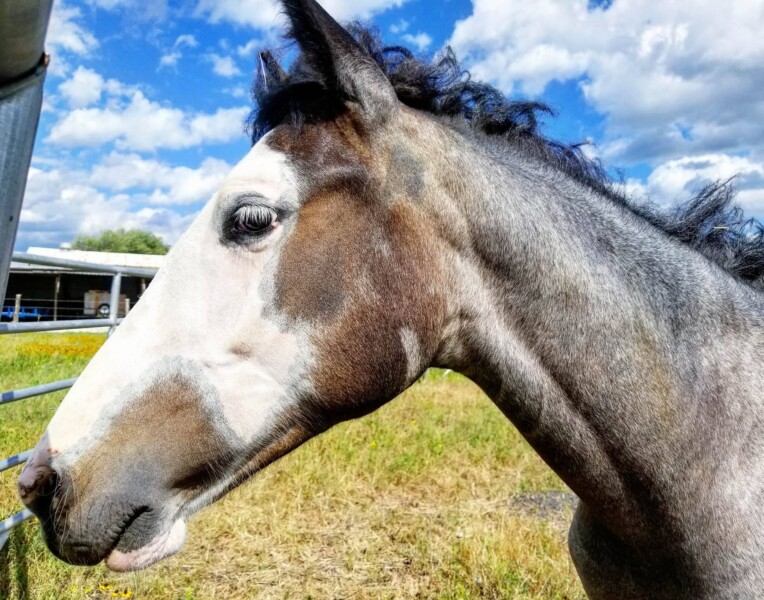
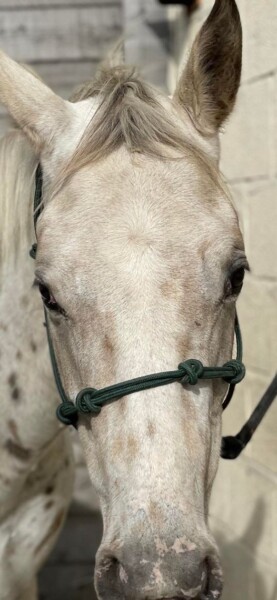
What little girl doesn’t need her own Pegasus?
Rusty is so good. He just rolls his eyes at us and behaves so nicely.
What little girl doesn’t need her own Pegasus?
Rusty is so good. He just rolls his eyes at us and behaves so nicely.
We’ve all seen the pleas, about to ship, this horse needs saved now.
I know there are pitfalls and a definite dark side to the slaughter horse industry. Setting that aside for the moment, what if you decide that you can’t let the horse go? How do you decide to take the chance and pull that horse? There are many reasons horses end up in kill pens. Lameness and behavioral issues are two big ones. There are also many good horses who end up there through shear bad luck. What are the odds that a pitiful looking horse you only get to see a few bad grainy pictures of could actually work out for you?
This is one place where whorls are put to perfect use. They aren’t always visible in those bad pictures. When they are, it is likely the only clue you will get as to what that horse will actually be like. I’ve seen a few of those ads where the whorls made me sad. The whorls on the horse made it unlikely that the horse could be rehabbed to a happy life. Maybe it would be better to put the time and money to use on a horse with more likelihood of a positive outcome.
Other times we can see a horse who is overlooked because of plain coloring or homely looks. The whorls and head show a willing, steady horse who would likely make a dependable mount for someone lucky enough to search out things more important than looks.
Looking at the whorls before purchasing any horse can help avoid heartbreak. A dressage or reining prospect with uneven body whorls will have a hard time reaching the upper levels. A hopeful child’s mount with a diagonal double whorl could make life miserable for both of them. When we are buying horses on the regular horse market though, we will be given much more information, a history, video, the life story. Kill pen horses come with none of that. They are a gamble. We need to do all we can to stack the cards in our favor.
This is my kill pen horse. Young and ugly at the time. He did come with the warning that he ran people over. With that lovely bit of information, these pictures, and, because he was lucky enough to have been sent to the sale with his papers, knowledge of his good bloodlines, I took the chance. Would knowing what the whorls were on him have changed anything? Not in this case. I was lucky to get a high double whorl. He lives up to everything we would expect from those. With training and care he learned not to run people over and is now practically perfect.
Understanding Horse Whorls is now available in paperback!
Since its release as an ebook in April of 2021 Understanding Horse Whorls has sold around the whorl. Here in the US, next door in Canada, from England to Australia, and even Norway, Germany, Paraguay, South Africa, Bulgaria, Germany, and the Netherlands.
People kept asking when it would be available in paper form? An ebook is great but a book you can hold in your hands has a special appeal. After lots of work and with a few new pieces of information the transformation is complete and ready to be offered as a real book.
Full of pictures and in depth explanations Understanding Horse Whorls covers the whorls on the head, as well as throughout the entire body, the meanings of head shape, and even possible effects of color are covered. From old stories to new science every aspect of horse whorls are explored.
Then in the end the individual pieces are brought together as we look at real horses and show how a horse whorl analysis is done.
I got the biggest surprise in the mail yesterday!
There was a box, with my name on it. I hadn’t ordered anything. We happily tore into it anyway. With a small child’s help we ripped the box open to find….
Beautifully wrapped horse stuff.
Behind the festive paper we hand crafted horse cookies, Molasses cookies with candy corn and pumpkins on top, which my child promptly ate 🤦🏼♀️ and pumpkin spice flavored cookies, which haven’t been eaten by children, yet. A beautiful spiderweb tail bag. The most darling little spooking horse sticker, that I had to fight the other child for. In my refusal to let it be wasted by randomly sticking it somewhere It may have gotten lost. I wanted to put it somewhere that I’d be able to enjoy it long term, so now I can’t find it anywhere 🙁 And my favorite of all, a nylon headstall! Not just a headstall, a headstall in the perfect shades of purples, pinks and oranges printed with pumpkins! And coffees, I’m betting pumpkin spice flavored coffees.
That one isn’t in the picture because I had to run out immediately and put it on a horse! It was so perfect we decided to do some Halloween type things while he was wearing it. We put a mask on and played fetch with the severed hand.
A big thanks to my mom for gifting me with the box and to Whinney Wear for packing such a great assortment of fall flavored horse fun!
It seems like forever that I’ve been saying this but
The print version of Understanding Horse Whorls is almost done!
I have here in my hands what will hopefully be the last proof copy. We are going over it carefully to make sure that all my mistakes have been found and fixed. Spelling and punctuation have never been my strong point. Not even close 🤣 It takes a village to find all my issues.
Then, within a week or so, the book will be available in paper form! I will of course let everyone know when and where to find it.
I had to call the repair shop about my trusty green mount the other day. Also known as the fourwheeler I usually drive. It is a good and faithful mount. The noises it had started making were not good. I wanted to get it looked at.
It became apparent that if it was going to be done I was going to have to be the one to do it. Girding my loins, I made the call.
They had all sorts of horrible questions they thought I should know the answer to, like, what kind is it? How am I supposed to know that! I know how to drive it. I know how to make it work cattle nicely. Knowing the breed is not my area. It is a Honda for future reference.
I felt like an idiot.
Yesterday I got to go riding with my best friend. Between children and the work we usually need to be doing we never get to ride. It was great.
I rode her horse, a big, steady, wonderful boy. He is usually ridden by her husband for ranch work, or her child because he is so trustworthy, back to that part where she seldom gets to ride because of children and what not. As a ranch horse he is great. He can do all sorts of things and is far better trained than my horses. In his area of expertise.
I put a leg on him to ask him to scoot over. He had no idea what I was talking about.
I could look at his lack of knowledge in that one area and assume he isn’t well trained. Like the mechanic at the repair place thought about me when I didn’t know the breed of fourwheeler. It is easy for us to form ideas about people and animals based on their knowledge of an area we know about. To think they are stupid or ignorant, judging them in one thing.
We all have our separate areas that we know about and are good at. We all have areas we know nothing about or are terrible at. This is a good thing. It wouldn’t do the world any good if all people were skilled in one area.
Appreciating everyone and everything’s unique skills and knowledge. Realize that they know way more than us about something. It will give us a whole new view of the world.
I’ve been looking at whorls on horses for decades. I’ve run cattle for not quite that long.
For some reason it never occurred to me to look at whorls on the cattle until recently. Even though so much of the good information we have about whorls came from studies on cattle. I had talked about them, looked at them, just not in an in depth sort of way.
Now I am actively trying to improve my cattle whorl knowledge. There is some really good information out there. I’m reading everything I can find and watching videos. Then taking all of that out to the pasture and looking closely at cattle.
The same ways I learned about horse whorls for the most part. Horses are different of course. We can ride them and see how they move and think. Most cattle aren’t ridden and the things we look at have more to do with milk quality, fertility, and health.
After watching some video by Steve Campbel I went out to check tanks and walked through the herd to see if I could find the markers he had talked about in real life.
This heifer stood out to me.
First of all she has a high ‘pancreatic’? line. I think that’s what it was called. It is a sign of pregnancy, health, and so on. If I remember right. Interestingly it was supposed to show up late in pregnancy. She can’t be very far along in pregnancy. The bulls were turned out in the middle of June. So what is it showing here?
Her build is even to slightly down hill. A cow should be lower in front than behind. It shows high fertility. Her hindquarters slope nicely down from the hip bones to the pelvic pins. The tail doc looks low and rounded. More ease of calving.
Her forehead whorl is a single, mostly centered. That shows a lick of extremes in temperament that we can see from the whorl. Some people say a nice easy going temperament. In horses the head can show lots of extremes that the whorl doesn’t. In cattle?
Her poll looks to be flat, not a sign of good fertility. I think the hair could be flattened down making it look that way and there might actually be a bump there. Apparently we want a small pointy bump. More fertility I think?
Her nose is broad. This one I remember because it was so interesting. The nose is about the same width of the pelvic pins in back. A wide nose shows a wide pelvis for ease of calving.
The front legs are wide at the knee then narrow sharply to the cannon bone, then slowly widen out to the hooves. I think. Most of the cows I looked at seemed to be shaped like this. Either I need to refine my ability to recognize this considerably, which I definitely do, or it could be a sign that the cattle are nicely bred. This is supposed to be a sign of tender meat. A good thing in beef cattle.
Her back is flat between the hip bones. This was good. Fertility? Ease of calving? Or maybe it was a sign she’d be a good doer? These things are so hard to remember. Learning any new skill takes lots of time and effort! we can’t read or watch something once and think we’ll have it down!
She is flat and broad all the way down the back. Her back whorl is just in front of her withers. Another good thing. Rich milk I believe?
I didn’t get a very good picture of her from behind. We can’t see the wrinkles in the skin over the udders. A sign of good rich milk and tenderness. There are whorls on either side of the hindquarters, more rich milk.
I’m going to try to keep a close eye on this heifer and see what sort of calf she raises, see how she does calving, see if she somehow is bred earlier than the other cows.
Does anyone here like to look at cow whorls? I would love a critique of my critique. It would also be great to hear what other people look for in cows.
For those people who aren’t lucky enough to live where there are nose flies, I wanted to share our lovely experience today.
I turned Rusty out to graze in the yard for awhile. I was going to get some non-horsey stuff done and let him take the edge off a bit, fill up on some grass. He walked straight to the place we worked yesterday and started calling me.
How can I resist that?
I got my things and went to work with him.
I asked for a lay down. He said, you know I’d like to. But there’s this bug?!
I assured him it was just a bot fly. NOT a nose fly. He would be ok. If I can find them I’m happy to do my best to kill a bot fly too. Sometimes I even manage. Today I couldn’t even see it, just had his word that it was there.
I thought maybe we could work on something different?
He took a few steps and said no. It was a nose fly. It was going to eat him. In just a few more seconds he was screaming SAVE ME!
Yes, I DO know that that was what he was saying. Look at him. How could you not hear it loud and clear?
He was running to me begging me to take care of it. I was searching frantically for the culprit while also trying to avoid being smashed. If you listen carefully you can hear me trying to reassure him that I am trying!
Finally I got his nose and covered it for him. Nose flies do, I think? fly up their noses. This is exactly the response horses have. Although this was fairly mild. Now imagine trying to ride a horse doing this? Having the horse on a leadrope and not being able to let him flee?
This is why we live in fear and dread of nose flies.
This was NOT a nose fly. They only come out for about a week in the first half of June. Fortunately or we all would have given up horses by now. This was a bot fly. Also evil. Not to the extent of nose flies though. The are about the same size, color and shape of a nose fly and hoover around the horses in the same manner. After an exceptionally bad nose fly season this year the horses are apparently traumatized and not willing to take a chance. When in doubt run!
The horses had all been hiding in the shed when I called Rusty. After he took off I found him waiting at the gate wanting back to the shed. Poor guy. Guess he can go hide in the shed instead of playing today.