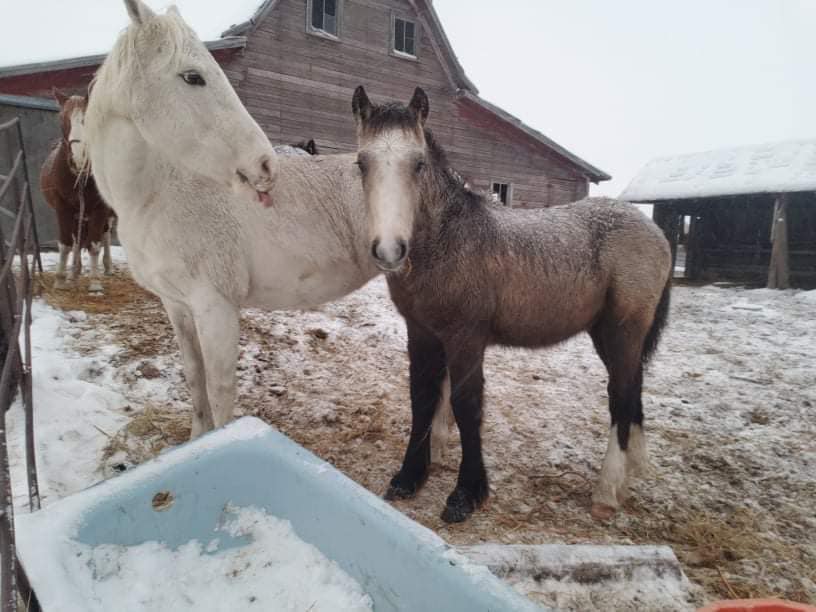
I decided that it would be fun to teach the horses numbers and see how far we could go with it from there. They already know colors. Numbers are the same concept, put a cue, word, with an object. What else can we do with it though? Can they learn an order? How about addition? Can they pair the picture, number, with a number of objects?
Double Whorled Complications
The slightest change in the location of a horse’s whorls can make huge differences in temperament.
No where is that more difficult to figure out than in side by side and diagonal double whorls. These whorls show almost exact opposites in temperament types among horses. The whorls themselves can be almost impossible to tell apart!
High side by side doubles can be two very clear whorls, in a straight horizontal line, touching or very close to each other. Or, one whorl can be barely visible, there can be lots of feathering, or not, or, most difficult of all, they can be set at a slight angle. When the side by side whorls are at a slight angle they have to be perfectly clear. The whorls can’t be faint and they do have to be very close together. These horses are extroverts, bold, brave, sensitive, will let you know exactly what they are thinking.
Diagonal double whorls are always set at an angle to each other, they can be set at a small distance apart. In fact that is one way to tell the difference. Diagonal double whorls are usually an inch or so apart and one of them is usually very faint and hard to see, a ghost whorl. Feathering will arch over, or under, the two whorls connecting them. When a diagonal double whorl looks like this they are easy to recognize. These horses are introverts, hesitant, need time to think things through, will draw into themselves and not show a reaction until they explode if you keep pushing and miss the subtle signs they’re upset.
The difficulty comes when the diagonal double is clear, easy to see, set close together, and only at a slight angle.
How do we tell this apart from a side by side double at a slight angle?
I don’t have a good answer. One possible way would be ears and head shape. Introverts tend to carry their ears back. Not laid back and mad, just facing backwards. Side by side whorls tend to have moose noses, bold features, convex, and sensitive. Right brain introverts tend to have very sensitive features and can also have convex profiles, making the difference even harder to tell.
So where do we draw the line? How do we tell for sure which diagonal double whorl will be introverts and which extrovert? I’m afraid I don’t know the answer to that. Here’s to more learning and getting this figured out!
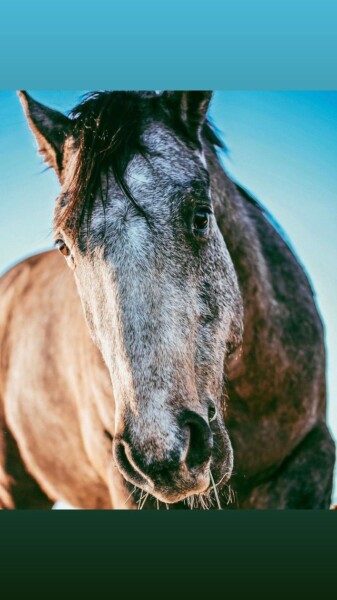
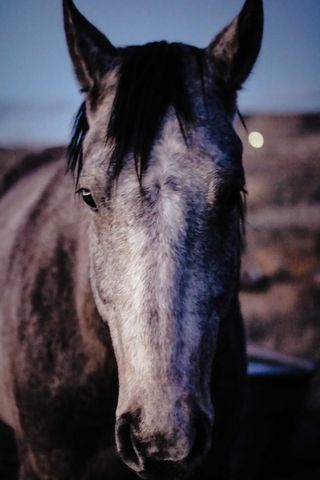
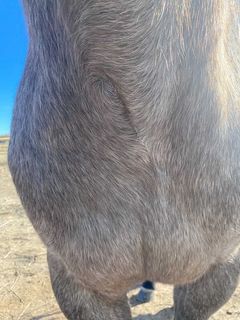
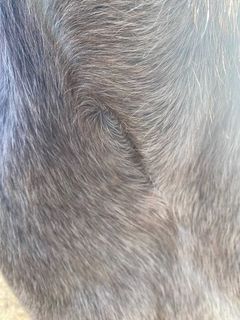
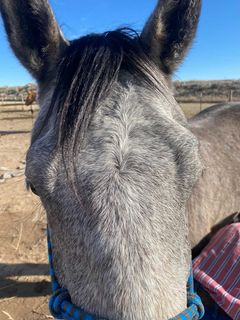
These two horses are not going to help solve this puzzle. One is a diagonal double the other side by side, according to their owners descriptions of temperament. Can you guess which is which? If we look closely there is a small difference in the whorl placement that seems to be our only clue.
- This one is a ide by side double
- This one is the diagonal double. There is a bit more of an angle to the whorls
Playing With Harvey
Chaining
Chaining:
Chaining is linking behaviors to create a new behavior.
We do this with almost every trick we teach our horses. We teach a few separate, simple behaviors. Then we put them together to form a big complicated behavior. Once they are put together the horse receives his reward at the end of the chain instead of after each piece of the chain like the do in the beginning. If we tried to teach the big behavior we would overwhelm the horse, confuse everyone, and get nowhere.
In chaining behaviors there are certain ways to put them together that are more effective than others.
That brings us to Back Chaining
Back Chaining:
When we start at the end of the trick, instead of the beginning, as we teach it. Then we teach each step back towards the very start of the trick.
Fetch is a trick, one of the many, that are taught using chaining. Picking something up, walking to us, carry the something, hand it to us. Trying to do it in that order can get confusing though. Instead I start by teaching the horse to target my hands with his nose. Then I start working on teaching them to hold an object, Then to bring that object a very short distance to my hands, gradually increasing the distance as he understands what is being asked.
By starting at the end of the trick the horse always knows what comes next. The hard part, the new part of the trick, is first. Then it gets rewarded by doing the piece the horse already knows and understands. As long as a hard piece is followed by an easy piece the horse will happily keep doing the hard and the easy thing. If an easy thing is followed by a hard thing the horse will stop wanting to do the easy thing.
The order that we do our training in is very important and makes all the difference.
Contrafreeloading
Contrafreeloading:
Contrafreeloading is when an animal would prefer to “work” or “play” for its reward versus simply being given food.
I had Heildof and Rusty out hoping to get them both worked with. While I played with one the other was free to roam about and graze. Rusty was happy to do so while I played with Heildorf. Those last bites of grass before winter sets in are cherished.
Then I lead Heildorf over to Rusty, let him go and grabbed Rusty.
Rusty and I were working on things when I heard a clatter behind me. Turning to look I saw Heildorf has stepped up onto the pedestal we had been working on. He was standing there looking around expectantly. Waiting patiently. I looked at the camera still set up and pointing at the pedestal but sadly no longer on and sorely regretted turning it off. I rushed back over to turn it on again! Even with all the green grass he could eat there at his disposal he would rather work for his food.
Contrafreeloading is the idea that animals in general, horses in this case, would rather do something to earn a reward than have it freely given. Obviously they aren’t going to turn down a cookie when we offer it just because we are glad to see them. When given a freely available resource though, they prefer to need to put in some effort to get it.
Is it that they enjoy the game? I hope so. If we make the effort too hard or not something they can enjoy they will happily go after the freely available resource. I’ve had that happen plenty of times when I ask for too much, or don’t explain clearly, in small steps what it is I’m asking for.
Whatever the reason that animals do this in general, I was happy to see that what Heildorf and I had been doing was apparently something he wanted to do more of. Bringing Rusty over I hurried to reward Heildorf’s efforts. Then we all spent some time hanging out on the pedestals.
Mare In For Training, Horse Whorls
High double side by side whorls show a horse who is sensitive, and an extremely quick learner. Bold, calm, curious, and confident, they can concentrate intently on a job but will get bored with repetition. You have to give them a reason to be interested, repetition bores them and they will start to look for other ways to entertain themselves. When that intelligence, sensitivity, and focus is properly contained they can be a super power. Without steady confident handling they can completely run over a person smashing through them literally as well as figuratively.
The whorls have feathering coming up from both of them. Feathering shows a brave and curious horse. They are thinkers who can think up all sorts of trouble with their very active minds. They are curious and clever, very friendly and add even more pushiness to an already assertive demanding horse.
A confident horse who has no hesitation about pushing through, or over people can cause trouble with the wrong people, ones who are easily intimidated. The traits themselves are in no way a bad thing. They can be an incredible thing. With the right training.
This mare was striking when unhappy and running people over when they tried to make her do things she didn’t want to do. She will not be forced into doing anything. In this case refusing dewormming or shots.
Luckily they sent her to the right place to find help. Positive reinforcement training works wonders with this type of horse. They can not be forced to do anything. If you can convince them that it will be a good thing and give them proper incentive, these horses will do anything for you. They will also stand at the gate and demand that you come work them with the same fervor that they refuse to do things that are forced on them. The determination and focus they are able to give needs to be directed in a healthy happy fashion. Once that is accomplished they make amazing horses, fearless, sensitive, devoted.
Looking at whorls on horses is not about labeling them, jumping to conclusions before allowing the horse to tell us who they are. It is about gaining every clue we can to what will best suit the horse. It is about finding the best matches between horse, human, and training style before huge commitments are made to everyone’s detriment.
Beyond the whorls on the head we can look at the rest of the body and see how the horse will move. Whorls are closely tied to conformation and muscle capability.
One her chest this mare has a small center whorl. That will bring her neck down to come lower out of the chest and put her a bit onto the forequarters. It is small so the effects it has shouldn’t be overly dramatic.The whorls on the crest of the neck show where she will bend through the neck when she tucks her nose. Whorls on the underside of the jaw are easily over looked but extremely important. When these aren’t evenly placed it will affect the entire body to the point that front hooves will grow unevenly. Even the whorls on the underside of the belly have information to give us. Where these are placed is where the hind legs will track. Hers appear to be mostly even, spaced moderately apart, and up a nice distance under the belly. Sometimes they will be in the center or placed with one far forward and one towards the back. In extreme cases one side wont have a whorl at all. Those horses have lots of trouble controlling hind legs and performing basic gaits.
This mare has all the makings of a very nice horse. No body issues and forehead whorls that can make a great horse. Hopefully when she goes home the training will be able to continue.
Bay Gelding, Horse Whorls
I stopped by to see my friend Verla Schear, of Schear Quarter Horses, the other day. She breeds some very nice horses. This one is not of her breeding but is still a very nice horse. She says he is great fun to ride cutting cattle.
The first thing we noticed looking at him was his perfectly straight profile, steady. The nose bone is pronounced though, determined. His chin has some slight dips and ridges to it for a slightly complicated temperament. At each temple he has small whorls, this shows a horse who is a thinker, extremely smart they spend a lot of time thinking up ways to keep themselves entertained and can often out think their people.
From the front we see a slightly high whorl for some slight extrovert traits, emotional, reactive, sensitive. Most of Verla’s horses had high whorls. Most of her horses are bred to be good cow horses, fast moving and alert. I don’t think it is coincidence that they have whorls that go along with that desired temperament type. He has large well defined brain muscle, it is supposed to show a smart horse, if nothing else it shows a healthy horse without apparent teeth or jaw issues.
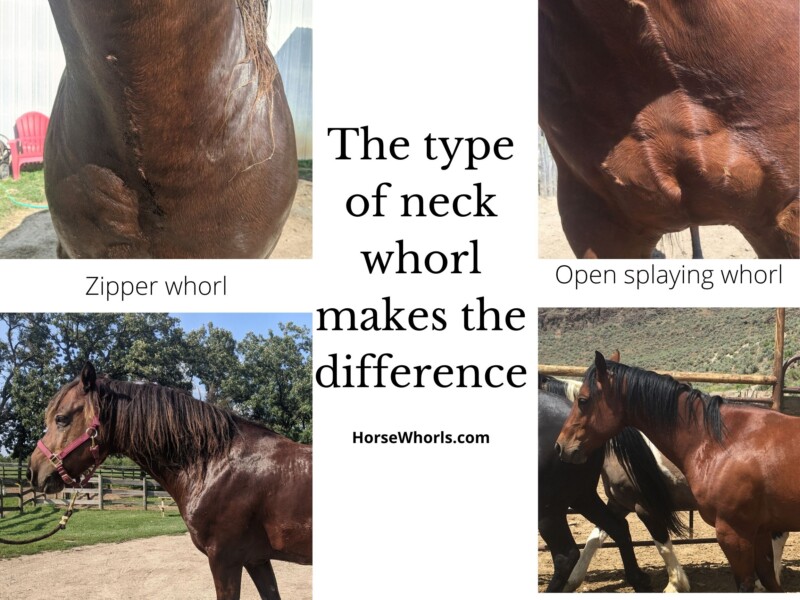
His chest was very interesting. A low zipper whorl. This shows a horse who will work well off the hind quarters, being set low will give an arched neck without being set high. The pectoral whorls are high, almost like a shield, the hair is growing upwards until it reaches mid chest. I don’t know the exact trait that this accompanies.
His flank whorls end fairly high. We can see straight hind legs set well out behind him. A flank whorl that ends high shows a horse who wont reach up under themselves with the hind legs. How does that go with the zipper whorl?That is a very good question.
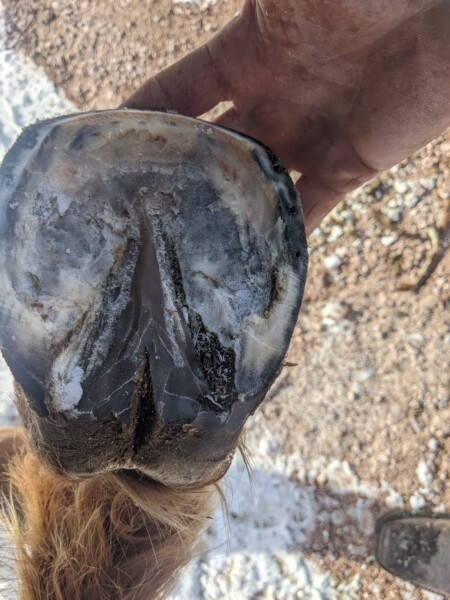
While looking at the flank whorls I noticed a slightly clubbed hoof behind. Because we had already looked at the rest of his whorls without seeing a reason for this I had to investigate further.
Not being willing to stick my head under the belly of an unknown horse, I stuck my camera under there instead. His belly whorls were very uneven! They were both set right up against the sheath. One of them, the one on his left, is just out on the belly. The other one is actually on the side of the sheath. The belly whorls show where a horse will track with the hind feet. Not very far up underneath himself, which we see also from the flank whorls, and towards the center. I’m not saying that the belly whorls are the cause of the very slight abnormality. They are certainly related though. The hoof doesn’t cause him any trouble and he is completely sound. It sure is an interesting trait to me at least.
All of this combines to make a horse who is reactive and quick to move after a calf, smart enough to think about how he can better be ready for the next move cattle might make, but also steady and dependable. He is Verla’s go to horse for getting work done, steady, dependable, and fun to ride.
Interview, Horse Whorls
Negative Punishment
It’s hard to get past the idea that something bad has to be done before we can reward for being good.
We run into that problem with horses all the time. We think a horse needs to pull back before we can teach them to give to pressure. We think a horse has to spook before we can teach them things aren’t scary. We think a horse needs to say no before we can teach them to say yes.
It is easily over looked that we should be rewarding our horses for doing good without waiting for that spook or pull first. Think of all the trouble we could avoid if we didn’t wait for the bad but looked harder for the good that was offered willingly?
The school my children go to is trying very hard to use positive reinforcement with the children. Finding a reward that is motivating is much harder for teenagers than it is for horses. Finding a high enough value reward is only part of the problem they are facing though.
That idea that bad has to be done before we reward good is so deeply ingrained in all people, not just horse people.
Lots of children are well rewarded for lots of things. Children who are having trouble reading are rewarded for any improvement. Children who can’t sit still are rewarded for stillness. It works nicely in many areas. Children who don’t get work done are rewarded for turning in assignments.
The children who read well, sit still, do their work, try hard all the time, seldom get rewarded. They watch the children who seldom perform the behaviors being asked of them receiving a high rate of reinforcement and wonder why they are trying? Should the reward for doing good be intrinsic? Yes, in large part it should. Convincing an elementary students of that as they watch another child get treats and trinkets is a little more difficult.
Do the other children need a higher rate of reinforcement? Yes. They most likely do.
Does that mean that children who are performing the desired behaviors don’t need rewarded? No. It most certainly doesn’t.
When we withhold a reward we are performing positive punishment. When these children are watching another child receive something while they get nothing for the same behavior that is strong negative punishment.
Don’t think they don’t notice. Comments are made all the time. As the children get older the negative punishment achieves exactly what it would be expected to. Many children stop trying. They get bitter about the rewards. We have conditioned them to negative associations with the rewards and the work the rewards are supposed to be rewarding.
What if instead we looked for the good that was willingly being offered?
There are no easy answers. Horses are so much easier to train than children. The try should always be rewarded though. If we punish the try we soon loose the greatest power a child, or horse, possesses.
Phrenology, Horse Whorls
-
the detailed study of the shape and size of the cranium as a supposed indication of character and mental abilities.
This was once considered to be a valid science well studied and deeply believed. Now we dismiss it and mock former believers.
Yes, people in the past have been wrong. That is what science is. Trying to figure out what is going on in the world around us. Science often lands on the wrong answer a few times before getting it right. Just because people have been wrong in the past doesn’t mean they weren’t on track with the right basic idea. For example, people long ago thought that diseases were caused by the bad odors around them. They were close. It wasn’t the odors, and covering the odors with good smells didn’t cure disease.
The causes of the odors, rot, decay, filth, and sickness, did cause some of the disease and infection they were trying to cure by masking the odors. Once science was reached a point where germs were discovered we mocked those who thought a bad smell could cause disease. They were doing the best they could with what they had. The same with phrenology.
Another attempt that was on the right track.
That the outside of the body can give us clues as to what is going on inside still makes perfect sense. As with germs though we need to find the real cause and correlations. Not make assumptions based on what we think should be. The ‘inventor’ of phrenology arbitrarily decided what part of the head should correlate with which part of the brain. He did do some comparisons. He also placed traits on these spots such as a tendency to commit murder or theft. Such very exact meanings for a small bump in the head.
What does this have to do with the study of whorls?
To many people who dismiss whorl analysis as phony science, quite a bit. In reality there are similarities. The same as thinking bad smells cause disease is related to the discovery of germs. All studies have to start somewhere. We will make many wrong attempts at explanations before we find the correct answer. That doesn’t mean the early attempt were foolish. It means they had less to go on. Because of early attempts to explain natures phenomenons, we have shoulders to stand on. Each generation learns a little more and gives the next generation a head start in their studies.
Science is not a single concrete answer, it is an ongoing study.